
What the updated PBIS Division 296 calculator does, and what it leaves out
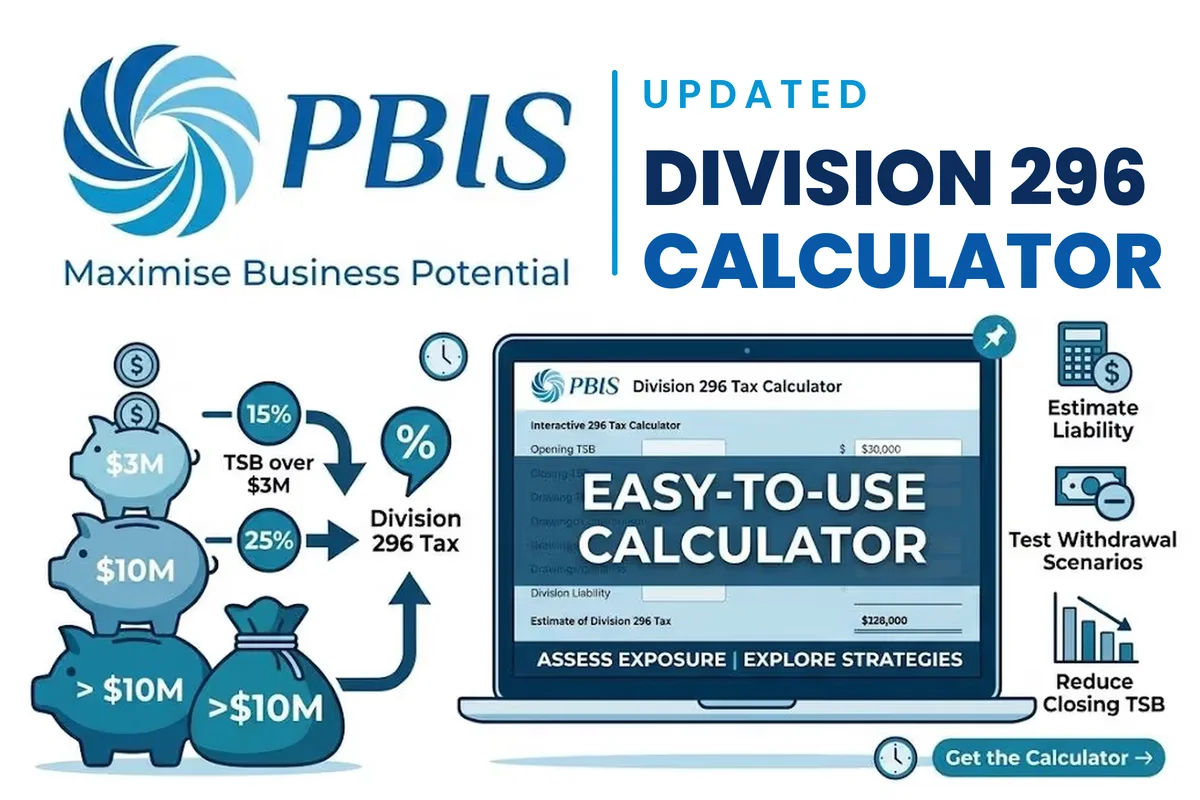
On 15 November 2026 we updated the free PBIS Division 296 calculator. It now follows the enacted law and the method the ATO publishes. This post sets out what the calculator does, what it leaves out, and which figures you need from the fund.
The calculator is for accountants, SMSF managers and advisers. It gives an estimate for one member. It is not a fund calculation, and it is not advice.
Try the Division 296 calculator
The law it follows
Parliament passed the Division 296 law in March 2026. The Treasury Laws Amendment (Building a Stronger and Fairer Super System) Act 2026 and the Superannuation (Building a Stronger and Fairer Super System) Imposition Act 2026 both received Royal Assent on 13 March 2026.
The tax applies from 1 July 2026. For 2026–27 the ATO sets the thresholds at $3 million and $10 million. Both are indexed in later years, in steps of $150,000 and $500,000.
What the calculator does
It follows the steps on the ATO’s page “How Division 296 tax is calculated”.
- It takes the member’s total super balance reference amount. For 2026–27 this is the balance at 30 June 2027. From 2027–28 it is the higher of the balance just before the start of the year and the balance at the end of it.
- It works out the percentage of that amount above $3 million, and the percentage above $10 million. Each is rounded to 2 decimal places.
- It multiplies the member’s total super earnings for the year by each percentage.
- It applies 15% to the earnings linked to the balance above $3 million, and a further 10% to the earnings linked to the balance above $10 million.
The results panel shows each step: the reference amount, the two percentages, the tax at each rate, the total, and the tax as a share of earnings.
Two income-year modes
You choose the income year first.
- 2026–27 (first year). Only the balance at 30 June 2027 is tested. This follows the transitional rule for the first year.
- 2027–28 or later. The calculator uses the higher of the opening and closing balance, so you enter both.
| 2026–27 (first year) | 2027–28 or later |
|---|---|
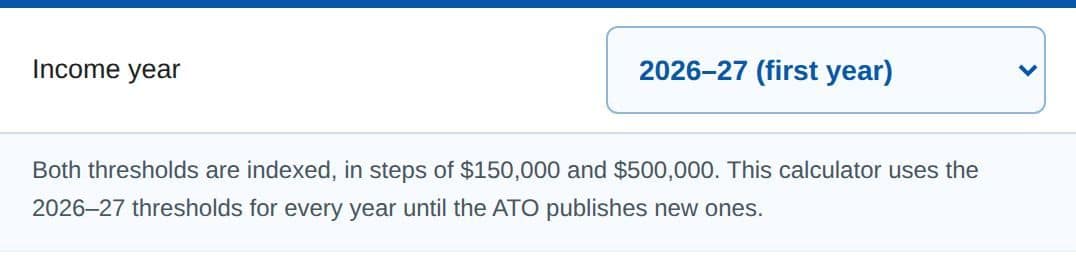
Tests the balance at 30 June 2027. |
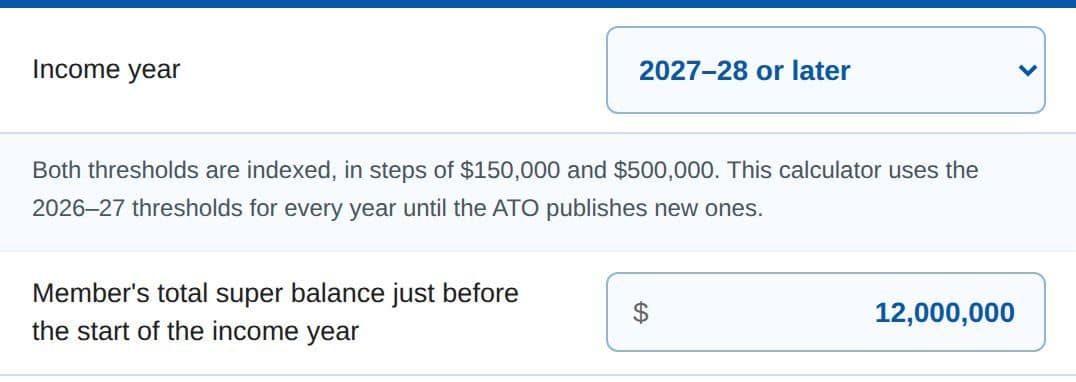
Tests the higher of the opening balance and the balance at the end of the year. |
The inputs
- The member’s total super balance just before the start of the year.
- The member’s total super balance at the end of the year. Count all of the member’s super funds and leave out limited recourse borrowing arrangement amounts.
- The member’s total super earnings for the year. This field is optional.
Total super earnings are the relevant super earnings each fund reports to the ATO for the member, added together. If you leave the field blank, the calculator assumes earnings of 5% of the end-of-year balance. That figure is an illustration, not the fund’s result. If earnings are nil or negative, the calculator shows no Division 296 tax.
Withdrawal scenarios
The calculator can model a withdrawal made by the last day of the income year. It keeps the year’s earnings the same and changes only the end-of-year balance. You can run one scenario, or 2 to 10 side by side against the same balance.
The effect depends on the year:
- For 2026–27 only the 30 June 2027 balance is tested, so a withdrawal made by that date lowers the percentage above each threshold while the year’s earnings stay the same.
- From 2027–28 the higher of the opening and closing balance is used, so a withdrawal during the year does not lower the percentage when the opening balance is the higher one.
A withdrawal can have other tax and super consequences that this calculator does not show. The scenarios show how the estimate moves. They do not tell you whether a withdrawal suits a client.
The ATO’s worked example
The page includes the ATO’s own example, so you can check the calculator against it.
A member has a total super balance of $12,000,000 at 30 June 2027 and total super earnings of $500,000 for 2026–27. The share above $3 million is 75%, and the share above $10 million is 16.67%. Tax is 15% of $375,000, which is $56,250, plus 10% of $83,350, which is $8,335. The total is $64,585.
| Step | ATO figure |
|---|---|
| Total super balance | $12,000,000 |
| Share of the balance above each threshold | 75% and 16.67% |
| Tax at 15% | 15% of $375,000 = $56,250 |
| Further tax at 10% | 10% of $83,350 = $8,335 |
| Total | $64,585 |
Enter the same figures in 2026–27 mode and the calculator returns the same result.
What it leaves out
The calculator estimates the member’s tax from a balance and an earnings figure that you supply. It does not do the fund’s work, and it does not cover every rule.
- Fund earnings. It does not work out a fund’s Division 296 earnings. For an SMSF the ATO describes these as an adjusted amount of the fund’s taxable income.
- Attribution between members. It does not split fund earnings between members. The ATO says an actuary will generally need to be engaged for this, with some exceptions.
- The cost base reset. It does not apply the optional CGT adjustment for assets an SMSF held at 30 June 2026. That election is made by the due date of the 2026–27 SMSF annual return and cannot be revoked.
- Defined benefit interests. These have their own earnings formula, and tax on them can be deferred. The calculator does not model them.
- Excluded and excepted cases. It does not model excluded interests, such as interests in foreign super funds. People the ATO lists as excepted, such as a member who dies in 2026–27, are not assessed.
- Other specific rules. The ATO lists specific rules for temporary residents who depart Australia. The calculator has no input for these.
- Future thresholds. It uses the 2026–27 thresholds of $3 million and $10 million for every year until the ATO publishes new ones.
- Assessment and payment. It does not show the timing of the ATO’s notice of assessment, the release election or interest on late payment.
- Other consequences. It does not show the other tax and super effects of a withdrawal.
For a member’s actual liability, the figures come from fund reporting and the ATO’s notice of assessment.
What you need from the fund
- The member’s total super balance at the end of the income year, across all funds, without LRBA amounts.
- For 2027–28 or later, the balance just before the start of the year as well.
- The member’s total super earnings for the year, if the funds have worked them out. Without them the 5% assumption applies.
Using the calculator in your firm
The calculator is free. Firms may embed it on their own site with their own branding, or use it internally, at no charge. Email growth@pbis.co to arrange this.
The calculator works in your browser. The figures you enter are not stored or sent to PBIS.
If you need illustrative Division 296 workings for your clients’ funds, PBIS can prepare them for your adviser or reviewer to check. Contact us.
Open the Division 296 calculator
Sources
- ATO: How Division 296 tax is calculated (last updated 3 November 2026)
- ATO: Division 296 tax on large super balances (last updated 3 November 2026)
- ATO: About Division 296 tax for SMSFs (last updated 29 June 2026)
- Federal Register of Legislation: Treasury Laws Amendment (Building a Stronger and Fairer Super System) Act 2026
Related reading
- Division 296 is reshaping SMSF advice
- SMSF and tax week in review: 9–15 November 2026
- Division 296 items on Trending
General information only. This post is not financial, taxation or legal advice and does not take account of anyone’s circumstances. It reflects the Division 296 law in force from 1 July 2026 and ATO guidance as at 15 November 2026.
General information only — not tax, financial, superannuation, or legal advice, and not a recommendation to act. It may be out of date. Check the credited source and get advice from a qualified professional about your own circumstances.