
Free tool, not a service
Division 296 tax calculator
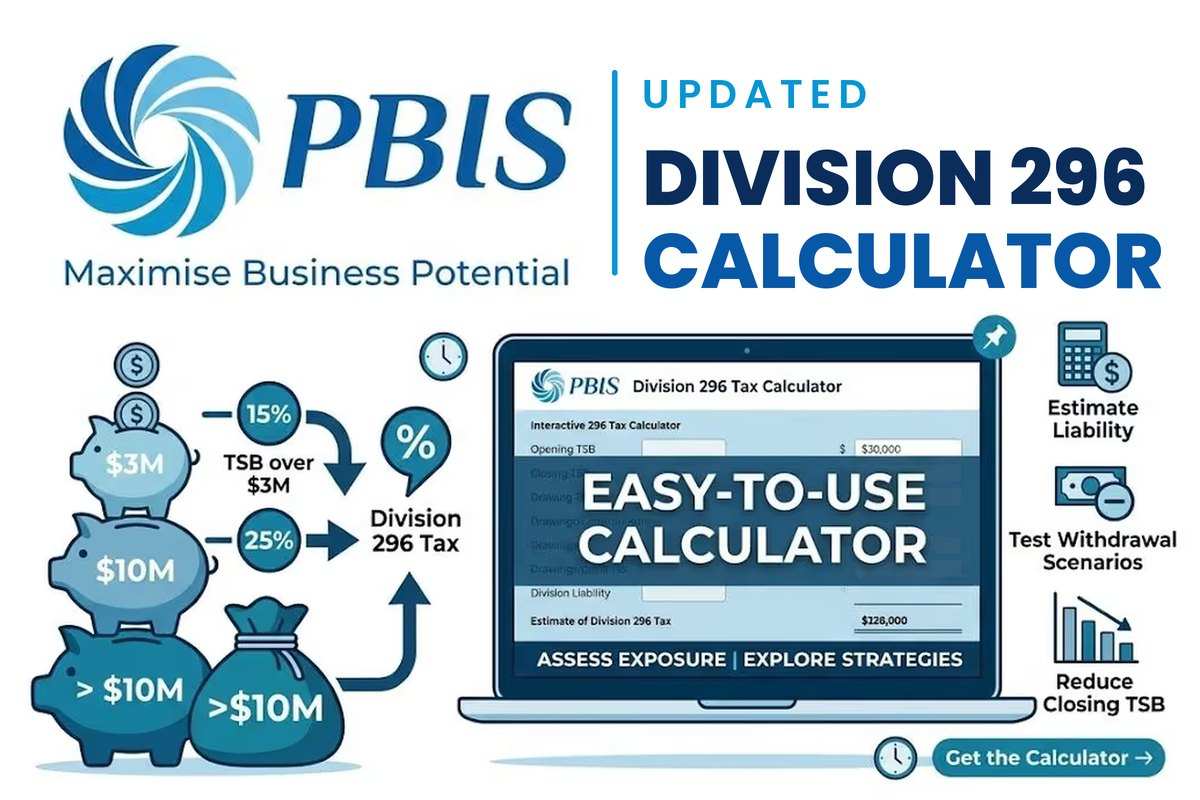
Estimate Division 296 tax on superannuation earnings for balances above $3 million and $10 million, using the method the ATO publishes. Enter the member's earnings or use an assumed rate, then test withdrawal scenarios. General information only.
Division 296 Tax Calculator
Division 296 tax applies from 1 July 2026. For 2026–27 it applies where a member's total super balance (TSB) across all funds is more than $3,000,000 at 30 June 2027 and their total super earnings for the year are more than nil.
- 2026–27 (first year): only the balance at 30 June 2027 is tested.
- 2027–28 onward: the higher of the balance just before the year starts and the balance at year end is used.
- Rates: 15% on the share of earnings above $3 million, plus a further 10% on the share above $10 million.
- The ATO assesses the member personally. The member can pay the tax or elect to have a super fund release the money.
Published by PBIS. Updated 15 November 2026 to follow the enacted law and the ATO's published method. Where no earnings figure is entered, earnings are assumed at 5% of the end-of-year balance.
Threshold
Threshold
General information only. This is not financial, taxation or legal advice and does not take account of anyone's circumstances. Based on the Division 296 law in force from 1 July 2026 and ATO guidance as at 15 November 2026.
Would you like to run multiple withdrawal examples?
Choose a starting mode. You can switch between Single Calculation and Multiple Calculations at any time, and you can clear all inputs with one click.
Embed this calculator in your firm's website
Firms may embed it with their own branding, or use it internally, at no charge. Email growth@pbis.co to arrange this.
Contact us about Div 296 workings
PBIS also provides SMSF administration and paraplanning support.
How the estimate is worked out
The calculator follows the steps the ATO publishes for Division 296 tax.
- Take the member's total super balance reference amount. For 2026–27 this is the balance at 30 June 2027. From 2027–28 it is the higher of the balance just before the start of the year and the balance at the end of it.
- Work out the percentage of the reference amount that is above $3 million, and the percentage above $10 million. Each is rounded to 2 decimal places.
- Multiply the member's total super earnings for the year by each percentage.
- Tax is 15% of the earnings above the $3 million threshold, plus 10% of the earnings above the $10 million threshold.
Worked example from the ATO
A member has a total super balance of $12,000,000 at 30 June 2027 and total super earnings of $500,000 for 2026–27. The share above $3 million is 75% and the share above $10 million is 16.67%. Tax is 15% of $375,000, which is $56,250, plus 10% of $83,350, which is $8,335. The total is $64,585.
Common questions
How is Division 296 tax worked out?
The ATO takes the member's total super balance reference amount, works out what percentage of it is above $3 million and above $10 million, rounds each percentage to 2 decimal places, and applies those percentages to the member's total super earnings for the year. Tax is 15% of the earnings above the $3 million threshold plus 10% of the earnings above the $10 million threshold.
Which balance is used?
For 2026–27 it is the total super balance at 30 June 2027 only. From 2027–28 it is the higher of the balance just before the start of the income year and the balance at the end of it. The balance covers all of the member's Australian super interests, and limited recourse borrowing arrangement amounts are left out.
What earnings figure should I enter?
Enter the member's total super earnings for the year. That is the relevant super earnings each fund reports to the ATO for the member, added together. For an SMSF the figure starts from the fund's taxable income, with adjustments, and a share is attributed to each member, generally by an actuary. If you leave the field blank, the calculator assumes earnings of 5% of the end-of-year balance. That is an illustration and not the fund's result.
Does a withdrawal before 30 June change the result?
For 2026–27 only the 30 June 2027 balance is tested, so a withdrawal made by that date lowers the percentage above each threshold while the year's earnings stay the same. From 2027–28 the higher of the opening and closing balance is used, so a withdrawal during the year does not lower the percentage when the opening balance is the higher one. A withdrawal can have other tax and super consequences that this calculator does not show.
What does this calculator leave out?
It does not work out a fund's Division 296 earnings, the optional cost base reset for assets an SMSF held at 30 June 2026, how earnings are attributed between members, defined benefit interests or excluded interests. It uses the 2026–27 thresholds of $3 million and $10 million for every year. Both are indexed and may rise in later years. People the ATO lists as excepted, such as a member who dies in 2026–27, are not assessed.
When is the tax assessed and paid?
The ATO works out the tax from what super funds report and sends the member a notice of assessment. For 2026–27 the ATO expects to start issuing assessments in the later half of the 2027–28 income year. The tax is generally due 84 days after the notice is issued, and the member has 60 days from the notice to elect to have a super fund release the amount.
Read more: What the calculator does, and what it leaves out
Sources
- ATO: How Division 296 tax is calculated
- ATO: Division 296 tax on large super balances
- ATO: About Division 296 tax for SMSFs
Checked 15 November 2026.
Need illustrative Division 296 workings for your clients' funds? PBIS can prepare them for your adviser or reviewer to check.